
We previously studied the application of
voltage divider rule
with various examples. In this post, you'll learn the method to apply voltage divider on three
series resistors
.
Statement: Three resistors of 22 Ω, 44 Ω, and 66 Ω are connected in a series configuration. The input voltage source is a 12 V battery. Apply the voltage divider rule to find the current across three resistors. Mention the observations.
Solution: Let's rewrite the general voltage divider formula:
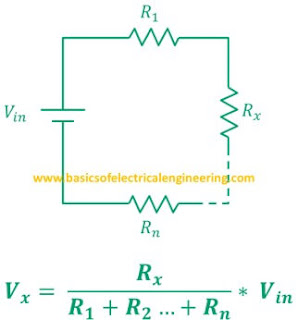 In the present case we have three resistors. So
V
x
. = [R
x
/ {R
1
+ R
2
+ R
3
} ] *V
in
Statement: Three resistors of 22 Ω, 44 Ω, and 66 Ω are connected in a series configuration. The input voltage source is a 12 V battery. Apply the voltage divider rule to find the current across three resistors. Mention the observations.
Solution: Let's rewrite the general voltage divider formula:

asdas
For R 1 > V 1 = [R 1 / {R 1 + R 2 + R 3 } ] *V in = [22 Ω/ {22 Ω + 44 Ω + 66 Ω} ] * 12 V = 2 V
For R 2 > V 2 = [R 2 / {R 1 + R 2 + R 3 } ] *V in = [44 Ω/ {22 Ω + 44 Ω + 66 Ω} ] * 12 V = 4 V
For R 3 > V 3 = [R 3 / {R 1 + R 2 + R 3 } ] *V in = [66 Ω/ {22 Ω + 44 Ω + 66 Ω} ] * 12 V = 6 V
After solving this problem we observe that the higher the resistance, the more voltage is dropped across it.


No comments:
Post a Comment