

In parallel electrical circuits, the current doesn't remain same. The current divide rule is used to find the divided current in parallel circuits. What you'll learn:
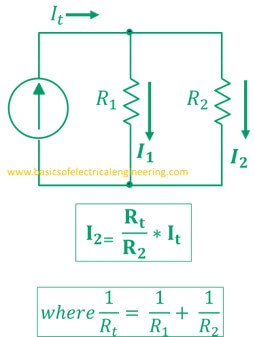
We can modify the previous equation to obtain an alternative formula:

Let's solve an example to better understand the formulas.
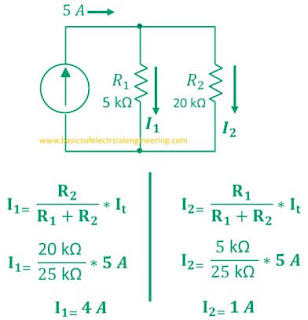
Example # 1: A 5 kΩ resistor connects in parallel to a 20 kΩ resistor. 5 A current enters the node. Find the current across both resistors.
Solution:
- The statement of current divider
- General formula
- Formula for two resistors with Examples
- Formula for three resistors with Examples
- Its derivation
Statement and formula of Current Divider
Statement:
The electrical current entering the node of a parallel circuit is divided into the branches. Current divider formula is employed to calculate the magnitude of divided current in the circuits.
Let's understand the basic definitions:
Node: A point where two or more than two components are joined.
Parallel circuit: The circuit in which one end of all components share a common node, and the other end of all components share the other common node. You can learn more about parallel circuit configuration here.
Node: A point where two or more than two components are joined.
Parallel circuit: The circuit in which one end of all components share a common node, and the other end of all components share the other common node. You can learn more about parallel circuit configuration here.
General formula
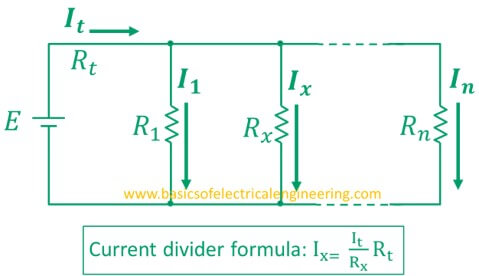
A parallel circuit with 'n' number of resistors and an input voltage source is illustrated below. We are interested to find the current which is flowing through R
x
.
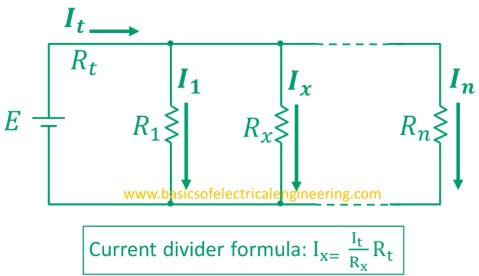
In the above formula:
I x : The current through R x .
I t : The total current which enters the circuit.
R x : The resistance of the component whose current value is to be determined
R t : The equivalent resistance of the parallel circuit
Let's consider a parallel circuit having two resistors R
1
and R
2
. The current I
t
enters the node. We are interested to calculate the current that is flowing through. The general formula and circuit now take the form:

In the above formula:
I x : The current through R x .
I t : The total current which enters the circuit.
R x : The resistance of the component whose current value is to be determined
R t : The equivalent resistance of the parallel circuit
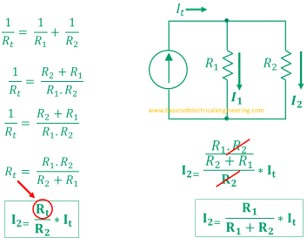
For two resistors

We can modify the previous equation to obtain an alternative formula:
Let's solve an example to better understand the formulas.
Example # 1: A 5 kΩ resistor connects in parallel to a 20 kΩ resistor. 5 A current enters the node. Find the current across both resistors.
Solution:

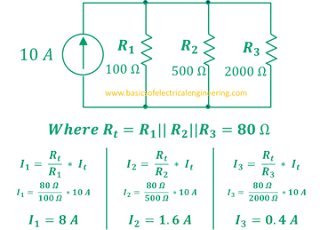
Current divider rule for three resistors
Let's consider the third case where we have three parallel resistors. The easy method which should be followed here is to find the equivalent resistance first, and then to apply the original formula:

Derivation of Current Divider formula
The derivation of CDR formula is very simple. Let's reconsider the general circuit:
Apply the Ohm's law on R
x
.
I
x
= E/R
x
where E = I
t
R
t
.
I
x
= I
t
R
t
/R
x
.
or
I
x
= [R
t
/R
x
] * I
t
So that was all about the Current Divider.
You can practice some more examples here to develop more concepts and knowledge on Current Divider circuits:
You can practice some more examples here to develop more concepts and knowledge on Current Divider circuits:


![Basic Properties of Electrical Circuits: Voltage, Current, Resistance, Power [The Mountain Analogy]](/-bBCMdrhXXj4/WWzcjdFJOLI/AAAAAAAAC2Y/SI648RXRAyg4qk2RnxaQrsKv5zZ406lHQCK4BGAYYCw/w72-h72-p-k-no-nu/basic-quantities-of-electrical-engineering.png)

Very good. Thanks for this post. Do more like this.
Reply Delete