• Home
  • Privacy Policy
  • Contact us
  • About us

Basics of Electrical Engineering
  • Home
  • Theory
  • Get it on Android
Thevenin theorem

Thevenin Theorem with a Step by Step Example

EE August 28, 2017
The Thevenin theorem helps us to reduce the complex electrical circuits to a single voltage source and a single resistance. Many times th...
Read More
No comments:
Email This BlogThis! Share to Twitter Share to Facebook Share to Pinterest
Labels: Thevenin theorem
Current divider

Current divider Example # 5: Impact of Adding another Resistor

EE August 28, 2017
Solution: A current divider having two unknown resistors connects to an input source of 10 A. The current passing through one resistor is 4...
Read More
No comments:
Email This BlogThis! Share to Twitter Share to Facebook Share to Pinterest
Labels: Current divider
Current divider

What values of R1 & R2 will satsify the given conditions

EE August 28, 2017
Statement: Design a current divider which converts 1 A current to 20 mA output while developing a voltage of 2 V. Solution: Let's sta...
Read More
No comments:
Email This BlogThis! Share to Twitter Share to Facebook Share to Pinterest
Labels: Current divider
Current divider

Current Divider Example # 3: Finding Value of Unknown Resistor

EE August 28, 2017
A current source of 100 mA powers two parallel resistors, the first resistor is of 30 Ω and it receives 60 mA current, Find the value of th...
Read More
No comments:
Email This BlogThis! Share to Twitter Share to Facebook Share to Pinterest
Labels: Current divider
Current divider

Current Divider Example # 2: Two equal resistors having same values of 200 ohms

EE August 28, 2017
Statement: Two equal resistors having same values of 200 ohms connect in parallel to each other. Apply current divider to find the current ...
Read More
No comments:
Email This BlogThis! Share to Twitter Share to Facebook Share to Pinterest
Labels: Current divider
Current divider

Current Divider Example # 1: Two resistors with 500 ohm and 800 ohm

EE August 27, 2017
Statement: Two resistors of values 500 ohms and 800 ohms connect in parallel, Using the current divider formula find the current flowing th...
Read More
No comments:
Email This BlogThis! Share to Twitter Share to Facebook Share to Pinterest
Labels: Current divider
Series Parallel Networks

Introduction to Series-Parallel Network with Example

EE August 27, 2017
The series-parallel networks combine the series configuration with the parallel configuration in one circuit. Solving such networks is ...
Read More
No comments:
Email This BlogThis! Share to Twitter Share to Facebook Share to Pinterest
Labels: Series Parallel Networks
Kirchhoff's current law

Kirchhoff's Current Law Example # 1: H Shaped Network with 5 Resistors

EE August 26, 2017
Statement: An H shaped network with 5 resistors joins with a 10 A current source. Solve the circuit to find unknown currents. Solution:...
Read More
No comments:
Email This BlogThis! Share to Twitter Share to Facebook Share to Pinterest
Labels: Kirchhoff's current law
Basic Electronics

Basics of Diode

EE August 14, 2017
The diode is a two terminal component which allows the flow of AC in one direction and stops it in another direction. Download our Andr...
Read More
2 comments:
Email This BlogThis! Share to Twitter Share to Facebook Share to Pinterest
Labels: Basic Electronics
Transformers

Types of Electrical Transformers

EE August 09, 2017
A transformer is an electrical machine which changes the AC waveform from one voltage level to another. Our electronic gadgets and power ...
Read More
No comments:
Email This BlogThis! Share to Twitter Share to Facebook Share to Pinterest
Labels: Transformers
Power

Basics of Electrical Power Transmission Components

EE August 06, 2017
The overhead transmission lines transmit the electricity from the power station to consumers. The components of transmission lines are: ...
Read More
No comments:
Email This BlogThis! Share to Twitter Share to Facebook Share to Pinterest
Labels: Power
Power

Basics of DAM - Hydroelectric Power Station

EE August 04, 2017
The dam is a structure which uses potential energy of water and generates electricity. In this article, you'll learn about the basics ...
Read More
No comments:
Email This BlogThis! Share to Twitter Share to Facebook Share to Pinterest
Labels: Power
Power

Basics of AC and DC Power

EE August 03, 2017
Electrical power exists in two forms, the AC, and the DC in this section, you'll learn the basics of both. Electrical cells, batterie...
Read More
2 comments:
Email This BlogThis! Share to Twitter Share to Facebook Share to Pinterest
Labels: Power
DC Basics

Basics of Potentiometer

EE August 01, 2017
A potentiometer is three terminal resistor which provides variable resistance at its output. A potentiometer contains three parts. Base...
Read More
No comments:
Email This BlogThis! Share to Twitter Share to Facebook Share to Pinterest
Labels: DC Basics
Newer Posts Older Posts Home

Start here

  • Lec 1a: Basic Properties
  • Lec 2: SI units
  • Lec 3: Electrical Symbols
  • Lec 4: Ohm's Law
  • Lec 5: Series vs Parallel Circuits
  • Lec 6: Series-Parallel Circuits
  • Lec 7: Current Divider Rule
  • Lec 8: Voltage Divider Rule
  • Lec 9: Kirchhoff's Voltage Law
  • Lec 10: Kirchhoff's Current Law
  • Lec 11: Norton theorem
  • Lec 12: Thevenin theorem
  • Lec 13: Superposition theorem
  • Lec 14: Delta to Wye
  • Lec 15: Wye to Delta

Recent

Popular

  • Basics of AC and DC Power
    Basics of AC and DC Power
    Electrical power exists in two forms, the AC, and the DC in this section, you'll learn the basics of both. Electrical cells, batterie...
  • Basics of Potentiometer
    Basics of Potentiometer
    A potentiometer is three terminal resistor which provides variable resistance at its output. A potentiometer contains three parts. Base...
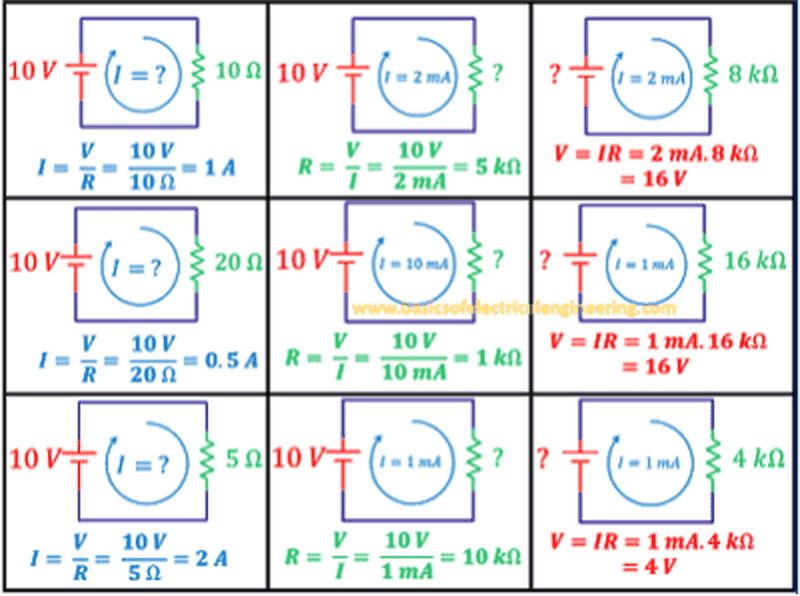
  • Ohm's Law
    Ohm's Law
    The amount of current flowing through any resistor is directly proportional to the amount of voltage applied across its ends. Mathemati...
  • Basic Properties of Electrical Circuits: Voltage, Current, Resistance, Power [The Mountain Analogy]
    Basic Properties of Electrical Circuits: Voltage, Current, Resistance, Power [The Mountain Analogy]
    Current, Voltage, Resistance, and Power are the four basic properties of electrical circuits. The mountain analogy in this article will hel...
  • Current or Voltage: What kills you | Basic Questions
    Current or Voltage: What kills you | Basic Questions
    While discussing basic of Electrical Engineering one of the most commonly discussed question is "What kills: ac or dc". After r...

Comments

Join at Facebook

Blog Archive

  • April (10)
  • March (4)
  • February (12)
  • January (27)
  • November (1)
  • October (23)
  • September (15)
  • August (14)
  • July (12)
Designed with by Way2Themes