

Statement: The sum of voltage rise in any electrical circuit is equal to the sum of voltage drops in that circuit.
Consider an electrical source with a voltage source which connects with three resistors. R 1 , R 2 and R 3 . The sum of voltage drops across these resistors is equal to the sum of the input voltage(voltage rise).
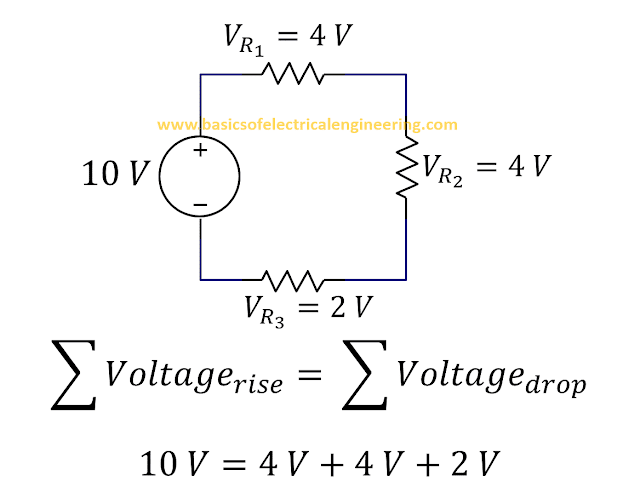
Here are a few examples of KVL which help you to learn it in a better way:
Consider an electrical source with a voltage source which connects with three resistors. R 1 , R 2 and R 3 . The sum of voltage drops across these resistors is equal to the sum of the input voltage(voltage rise).

Here are a few examples of KVL which help you to learn it in a better way:
Example 1: A 15 V input source powers three resistors, having a series current of 2 mA flowing through them. Find the voltage across R 3 .
Solution:
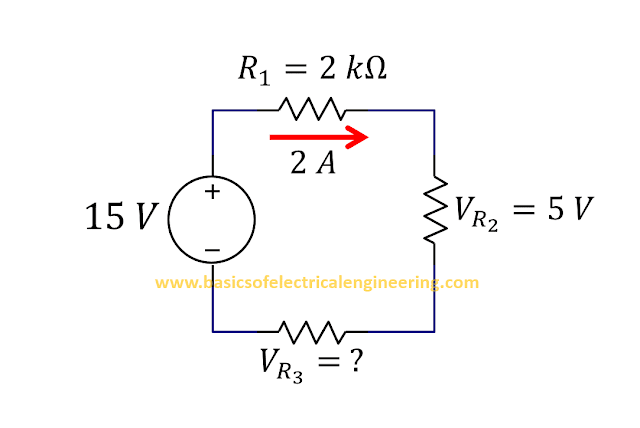
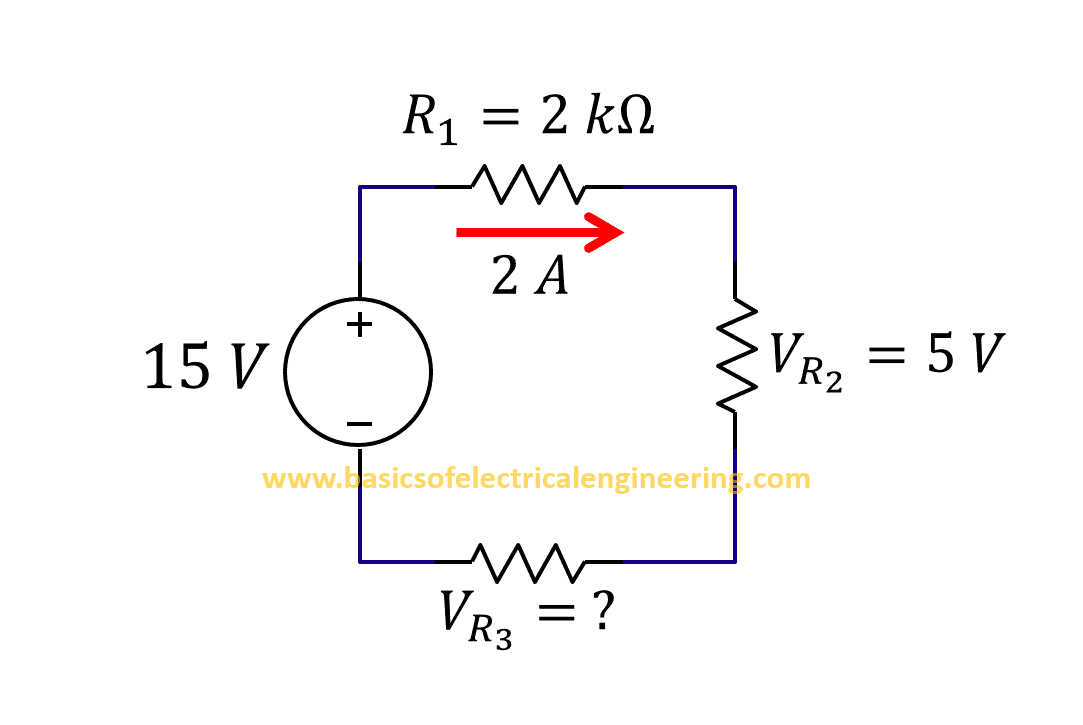
Step 1: Using Ohm's law find the voltage drop across the first resistor.
V = IR = 2 mA* 2 kohm = 4 V
Step 2: Applying KVL:
V_rise = V_drop
V_rise = V_drop
15 V = 4 V + 5 V + V_R_3
V_R_3 = 15 V - 5 V - 4 V = 6 V
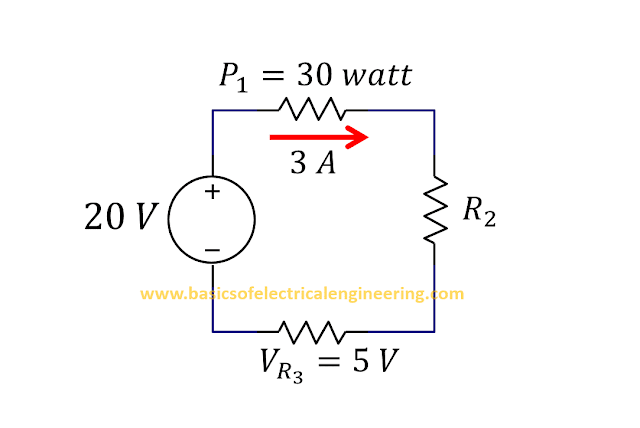
Example 2: A 20 V source powers three series resistors. The wattage rating of the first one being 30 watts having a current of 3 A flowing through it. The second resistance has all parameters unknown. Whereas, the third one has a voltage drop of 5 V across it. Find all unknown voltages in the circuit.

Step 1: Using formulas P = VI, or V = P/I = 30 watt/3 A = 10 V
Step 2: Using KVL;
V_rise = V_drop;
20 V = 10 V + V_R_2 + 5 V
or V_R_2 = 15 V


![Basic Properties of Electrical Circuits: Voltage, Current, Resistance, Power [The Mountain Analogy]](/-bBCMdrhXXj4/WWzcjdFJOLI/AAAAAAAAC2Y/SI648RXRAyg4qk2RnxaQrsKv5zZ406lHQCK4BGAYYCw/w72-h72-p-k-no-nu/basic-quantities-of-electrical-engineering.png)

No comments:
Post a Comment