

The current/voltage passing through any resistor is equal to the sum of current/voltage which is provided by all sources.
The electrical circuits often contain two or more than two sources. The current/voltage passing through any component in such circuit is equal to the combined effect of individual sources. The superposition principle helps to solve all such circuits.
While applying superposition theorem all sources are replaced and only one source is considerd at a time.
A current source is replaced by an open circuit and the voltage source is replaced by a short circuit.
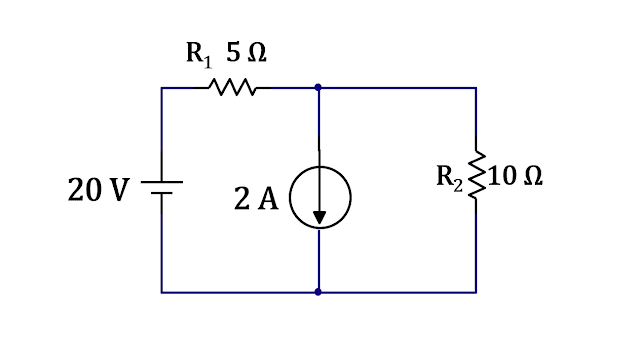
Step 1: Replacing the current source with an open circuit.



The electrical circuits often contain two or more than two sources. The current/voltage passing through any component in such circuit is equal to the combined effect of individual sources. The superposition principle helps to solve all such circuits.
While applying superposition theorem all sources are replaced and only one source is considerd at a time.
A current source is replaced by an open circuit and the voltage source is replaced by a short circuit.
Example of Superposition Principle
Statment: Find the voltage across R
2
Let's consider a circuit with two resistors and two sources.

The voltage passing through R
1
is equal to sum of voltage due to both voltage and current source. Similarly for R
2
.
Now let's find the voltage across R 2 .
Now let's find the voltage across R 2 .
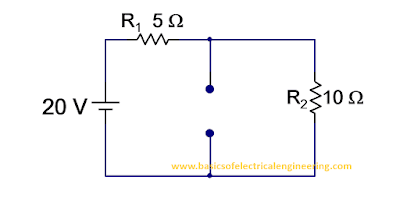
Step 1: Replacing the current source with an open circuit.

The circuit now contains two resistors which can be
easily solved using Voltage divider rule
:
Now to find the V_R_2:

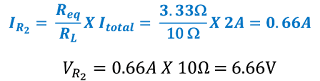
Step 2: Replacing the voltage source and then finding the voltage due to current source:

The easiest method is to first apply the
current divider
and then use the
Ohm's law
for finding the
current
passing through the
circuit.

Step 3: Adding the voltages
Finally the voltages are added to find the overall voltage.
The rule of polarities should be followed whilst adding voltages. Here the polarities of voltages is opposite. So the lumped effect is:


![Basic Properties of Electrical Circuits: Voltage, Current, Resistance, Power [The Mountain Analogy]](/-bBCMdrhXXj4/WWzcjdFJOLI/AAAAAAAAC2Y/SI648RXRAyg4qk2RnxaQrsKv5zZ406lHQCK4BGAYYCw/w72-h72-p-k-no-nu/basic-quantities-of-electrical-engineering.png)

No comments:
Post a Comment