• Home
  • Privacy Policy
  • Contact us
  • About us

Basics of Electrical Engineering
  • Home
  • Theory
  • Get it on Android
Sensors

Basics of Thermsitor [NTC Thermistor vs PTC Thermistor]

EE February 28, 2018
What is thermistor A thermistor is a two terminal component whose resistance changes with the change in temperature. It is also known as...
Read More
No comments:
Email This BlogThis! Share to Twitter Share to Facebook Share to Pinterest
Labels: Electronics , Sensors
Basic concepts

Ideal vs Practical voltage source [Formulas and Practical Examples]

EE February 25, 2018
An ideal voltage source provides a constant voltage at the output terminals regardless of the connected load. The case is not same as the ...
Read More
No comments:
Email This BlogThis! Share to Twitter Share to Facebook Share to Pinterest
Labels: Basic concepts
Basic Formulas

Formula for Voltage | How to calculate Potential Difference

EE February 22, 2018
We previously studied that voltage is the basic property of electrical circuits . Today you'll learn the basic definition voltage and i...
Read More
No comments:
Email This BlogThis! Share to Twitter Share to Facebook Share to Pinterest
Labels: Basic Formulas
Basic Formulas

HP to Amps Formula [DC, Single, 2 and 3 Phase AC Motors]

EE February 22, 2018
HP to Amps formula is used to calculate current from horsepower in single and three phase ac circuits as well as in DC circuits. The basic ...
Read More
No comments:
Email This BlogThis! Share to Twitter Share to Facebook Share to Pinterest
Labels: Basic Formulas
Power

Basics of Electricity Bills and kWH cost of Appliances

EE February 22, 2018
Electricity plays a vital role in our life, it charges our gadgets, powers our equipment and is responsible for running our industries. But...
Read More
No comments:
Email This BlogThis! Share to Twitter Share to Facebook Share to Pinterest
Labels: Power
Equipment

Basics of Digital Multimeter

EE February 21, 2018
The digital multimeter is used to measure voltage, current, and resistance. Modern multimeters can also be used to measure the frequency, c...
Read More
No comments:
Email This BlogThis! Share to Twitter Share to Facebook Share to Pinterest
Labels: Equipment
Examples

Voltage Divider Rule Example # 2: Three Resistors of 22 Ω, 44 Ω, and 66 Ω

EE February 20, 2018
We previously studied the application of voltage divider rule with various examples. In this post, you'll learn the method to apply v...
Read More
No comments:
Email This BlogThis! Share to Twitter Share to Facebook Share to Pinterest
Labels: Examples
Basics of Electrical Engineering

Volage Divider Rule [Statment, Formula & Examples]

EE February 19, 2018
The electrical current always remains same in the series components. However, the voltage doesn't remain same in series components. The...
Read More
No comments:
Email This BlogThis! Share to Twitter Share to Facebook Share to Pinterest
Labels: Basics of Electrical Engineering
DC Basics

Basic Properties of Electrical Circuits: Voltage, Current, Resistance, Power [The Mountain Analogy]

EE February 15, 2018
Current, Voltage, Resistance, and Power are the four basic properties of electrical circuits. The mountain analogy in this article will hel...
Read More
No comments:
Email This BlogThis! Share to Twitter Share to Facebook Share to Pinterest
Labels: DC Basics
DC Basics

Current Divider Rule [Statement, Formula, Examples, and Derivation]

EE February 14, 2018
In parallel electrical circuits, the current doesn't remain same. The current divide rule is used to find the divided current in parall...
Read More
1 comment:
Email This BlogThis! Share to Twitter Share to Facebook Share to Pinterest
Labels: DC Basics
Basics of Electrical Engineering

Series vs Parallel Circuit Configuration

EE February 13, 2018
Series and Parallel arrangements are two basic configurations in which we can arrange the electrical components. You'll learn: What...
Read More
No comments:
Email This BlogThis! Share to Twitter Share to Facebook Share to Pinterest
Labels: Basics of Electrical Engineering
Basic Formulas

Energy to Voltage Formula: 75 joules of Energy to Move 10.5 coulomb charge

EE February 04, 2018
Question: 75 joules of energy is required to move the 10.5 C charge between two points. What is the voltage between these two points? U...
Read More
No comments:
Email This BlogThis! Share to Twitter Share to Facebook Share to Pinterest
Labels: Basic Formulas
Newer Posts Older Posts Home

Start here

  • Lec 1a: Basic Properties
  • Lec 2: SI units
  • Lec 3: Electrical Symbols
  • Lec 4: Ohm's Law
  • Lec 5: Series vs Parallel Circuits
  • Lec 6: Series-Parallel Circuits
  • Lec 7: Current Divider Rule
  • Lec 8: Voltage Divider Rule
  • Lec 9: Kirchhoff's Voltage Law
  • Lec 10: Kirchhoff's Current Law
  • Lec 11: Norton theorem
  • Lec 12: Thevenin theorem
  • Lec 13: Superposition theorem
  • Lec 14: Delta to Wye
  • Lec 15: Wye to Delta

Recent

Popular

  • Basics of AC and DC Power
    Basics of AC and DC Power
    Electrical power exists in two forms, the AC, and the DC in this section, you'll learn the basics of both. Electrical cells, batterie...
  • Basics of Potentiometer
    Basics of Potentiometer
    A potentiometer is three terminal resistor which provides variable resistance at its output. A potentiometer contains three parts. Base...
  • Ohm's Law
    Ohm's Law
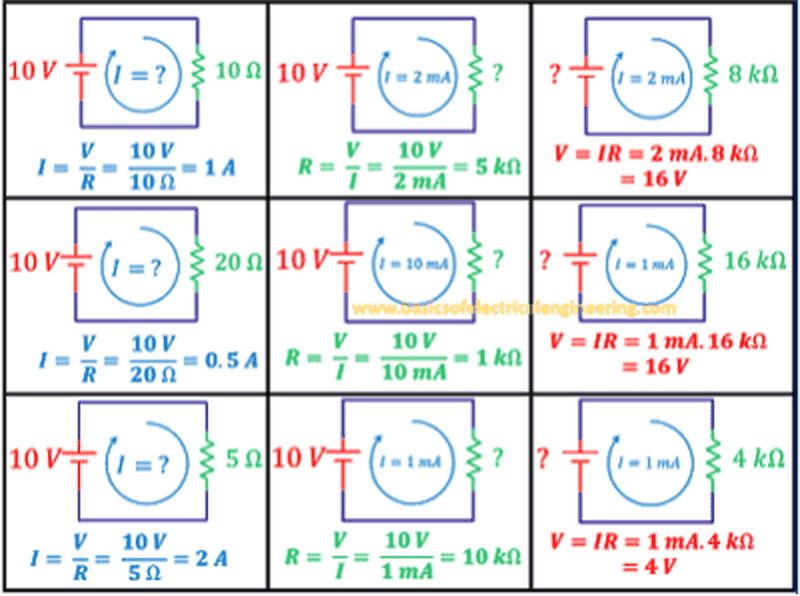
    The amount of current flowing through any resistor is directly proportional to the amount of voltage applied across its ends. Mathemati...
  • Basic Properties of Electrical Circuits: Voltage, Current, Resistance, Power [The Mountain Analogy]
    Basic Properties of Electrical Circuits: Voltage, Current, Resistance, Power [The Mountain Analogy]
    Current, Voltage, Resistance, and Power are the four basic properties of electrical circuits. The mountain analogy in this article will hel...
  • Current or Voltage: What kills you | Basic Questions
    Current or Voltage: What kills you | Basic Questions
    While discussing basic of Electrical Engineering one of the most commonly discussed question is "What kills: ac or dc". After r...

Comments

Join at Facebook

Blog Archive

  • April (10)
  • March (4)
  • February (12)
  • January (27)
  • November (1)
  • October (23)
  • September (15)
  • August (14)
  • July (12)
Designed with by Way2Themes