

The series-parallel networks combine the series configuration with the parallel configuration in one circuit.
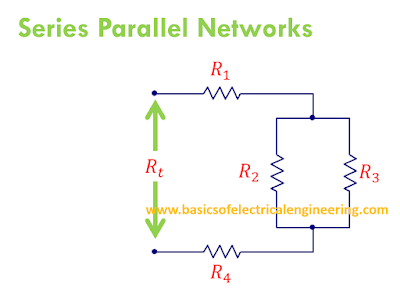

Solving such networks is very easy, provided one understands the series and parallel components. In the above case, R
2
and R
3
are joined in the parallel configuration. Let's say:
R
eq
= R
2
|| R
3
After solving them in parallel R
eq
now comes in series and all together we can write the equation:
R t = R 1 + (R 2 || R 3 ) + R 4 .
Example: Find the current provided by the voltage source in the resistive series-parallel network shown below.
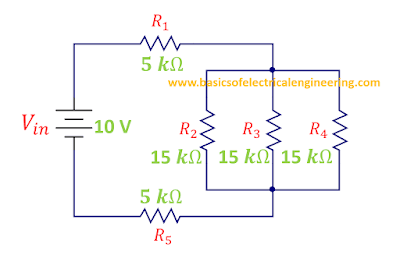
R t = R 1 + (R 2 || R 3 ) + R 4 .
Example: Find the current provided by the voltage source in the resistive series-parallel network shown below.

Solution:
Step 1: Solve R
2
, R
3,
and R
4
in the parallel configuration, the equivalent resistance for these three resistors will be R
eq1
= 5 ㏀.
Step 2: Add R
1
, R
5
, and R
eq1
in series.
R
eq
= R
1
+ R
5
+ R
eq1
= 15 kΩ which is the equivalent resistance.
Step 3: Finally, apply the Ohm's law to find the current:
I = V/R = 10 V / 15 kΩ = 0.66 mA
Which is the final answer.


![Basic Properties of Electrical Circuits: Voltage, Current, Resistance, Power [The Mountain Analogy]](/-bBCMdrhXXj4/WWzcjdFJOLI/AAAAAAAAC2Y/SI648RXRAyg4qk2RnxaQrsKv5zZ406lHQCK4BGAYYCw/w72-h72-p-k-no-nu/basic-quantities-of-electrical-engineering.png)
![Current Divider Rule [Statement, Formula, Examples, and Derivation]](/-N2qCkKhSbLk/WoPosMEnFII/AAAAAAAAEP4/Zd9fKT2IM5Y6mUSrS1VDII1zyRbkHYDPwCK4BGAYYCw/w72-h72-p-k-no-nu/general-current-divider-formula.jpg)
No comments:
Post a Comment