

We previously studied that voltage is the
basic property of electrical circuits
. Today you'll learn the basic definition voltage and its formula.
Voltage can also be defined as the ratio between energy and charge.
Definition # 2: 1 volt is defined as one joule of energy which is required to move the one-coulomb charge from one point to another.
Formula : From above statement, we can explain voltage as:
V = [W/Q]
where
V = Voltage in volts
W = Energy in joules
Q = Charge in coulombs
What is voltage | Definitions
Definition # 1: The potential difference between two points is known as voltage.Voltage can also be defined as the ratio between energy and charge.
Definition # 2: 1 volt is defined as one joule of energy which is required to move the one-coulomb charge from one point to another.
Formula : From above statement, we can explain voltage as:
V = [W/Q]
where
V = Voltage in volts
W = Energy in joules
Q = Charge in coulombs
| Name | Formula |
|---|---|
| Voltage Formula |
V =
W
/
Q
|
| Voltage to Energy | W = QV |
| Voltage to Coulomb |
Q =
W
/
V
|
Examples
Example # 1: 80 J of energy is required to move a 10 C of charge between two points. Find the potential difference.
Solution: V = W/Q = 80 J / 10 C = 8 V
Example # 2: The potential difference between two points is 12 V. How much energy is required to move a 5 Coulomb charge between these points.
Solution: W = QV = 5 * 12 = 60 joules
Example # 3: The energy required to move a charge between two points having a potential difference of 5 V is 50 J. Find the amount of charge in coulombs.
Solution: Q = W/V = 50 J / 5 V = 10 coulomb
What actually the potential difference is
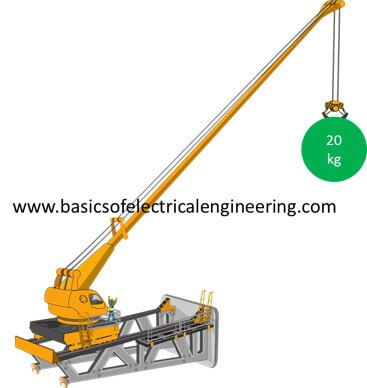
One might feel it difficult to understand voltage. However, it can be easily be understood by comparing it with the mechanical potential energy. Consider the pulley on a crane which is hoising a 20 kg bag of stones.

Now if we drop that 20 kg weight from the height it will do work. The weight did its work because we provided it a potential energy.
In a similar fashion if we separate two unlike charges (+ve and -ve) by doing some work. This gives them potential energy to do work. And they will return back the energy when they are connected to some external circuit.
Let's summarize our results in to tabulated form:
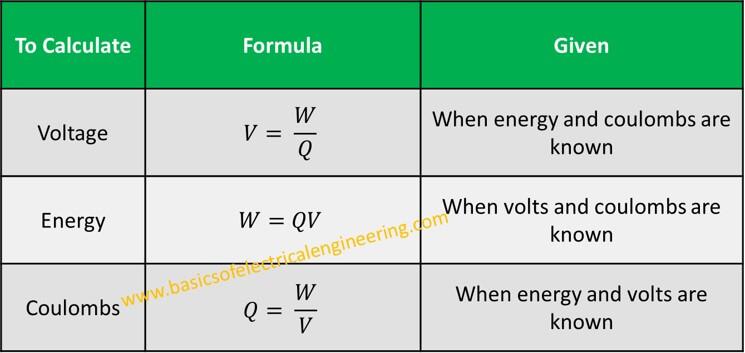
Let's summarize our results in to tabulated form:




No comments:
Post a Comment