

Branch current analysis is a method used for calculating current in each branch.
The branch current analysis uses the combination of Kirchoff's current and voltage law to obtain a set of linear equations. These linear equations are then solved to achieve the value of current flowing in branches.
Follow these steps to solve a circuit using branch current analysis:
The branch current analysis uses the combination of Kirchoff's current and voltage law to obtain a set of linear equations. These linear equations are then solved to achieve the value of current flowing in branches.
Follow these steps to solve a circuit using branch current analysis:
- Assign the arbitrary direction of current to all branches.
- Apply Kirchhoff's voltage law to all loops.
- Apply Kirchhoff's current law to all nodes.
- Solve the equations.
The example below provides a clear insight of steps.
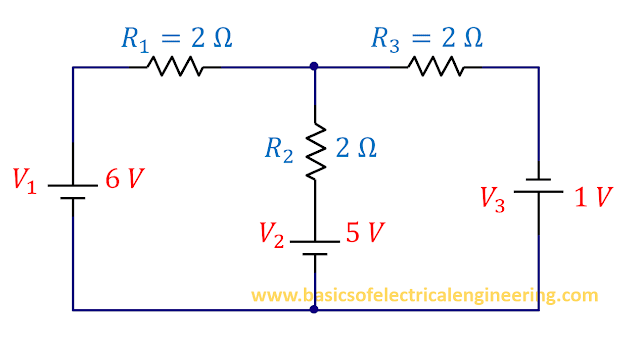
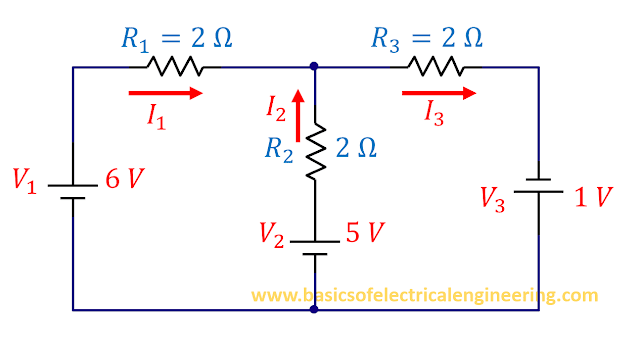
Example: Find all the branch currents in the circuit.

Solution:
Step 1: First of all assign the arbitrary current directions to all branches.

Step 2: By Applying Kirchhoff's voltage law to the left loop we get:
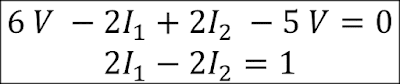

Step 3: Apply KVL to the right loop:
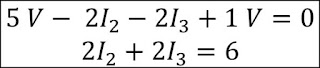
Step 4: Apply KCL to the node.
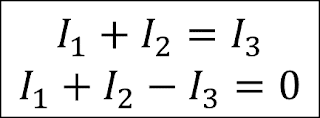
By solving these linear equations we get the final answers for currents:
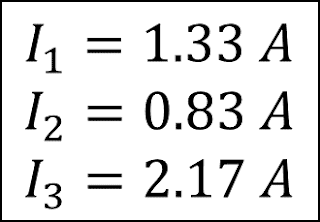

Step 4: Apply KCL to the node.

By solving these linear equations we get the final answers for currents:


![Basic Properties of Electrical Circuits: Voltage, Current, Resistance, Power [The Mountain Analogy]](/-bBCMdrhXXj4/WWzcjdFJOLI/AAAAAAAAC2Y/SI648RXRAyg4qk2RnxaQrsKv5zZ406lHQCK4BGAYYCw/w72-h72-p-k-no-nu/basic-quantities-of-electrical-engineering.png)

I got for Step 3:
Reply Delete4V -2I2 +2I3 = 0 .
Sorry that is a typo mistake will correct the first line of step A. The second line is correct however.
Reply Delete