

LED (light emitting diode) is an electronic component which emits electrical light.
In this post, you'll learn about:
You can
check the full-color chart here.
In this post, you'll learn about:
- Symbol and construction of LED
- How it works
- How it exhibits different colors
- Resistor & LED Calculations
- Introduction to the 7 Segment LED Display
- Difference between LED and photodiode
Symbol and Construction
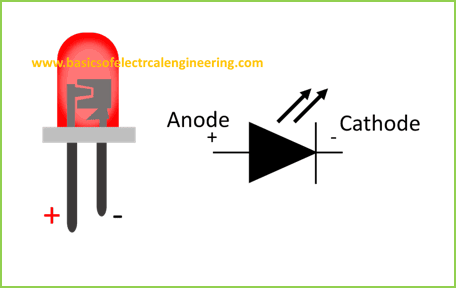
It is a two terminal device which contains a pn juction. The two terminals are namely the cathode and the anode. Manufacturers indicate the cathode by keeping it longer in length as compared to the anode.

How it works
During forward bias the electrons from n region cross the pn junction and combine with holes in p region. Electrons are at higher energy level than holes and this energy difference results as the visible light. During combination process, the electrons release energy in the form of photons.
How it exhibits different colors
The color of light emitting diode depends on the wavelength of emitted light. This wavelength depends on the material used during the manufacturing process. Different materials are added in different proportions for achieving the colors. The details below presents a summarized review of colors and bandwidth.
| Color | Wavelength (nm) | Forward voltage (V) | Material |
|---|---|---|---|
| Infrared | 850-940 | 1.7-1.5 | GaAIAs (Gallium Aluminum Arsenide) |
| Red | 633 | 2.2 | InGaAIP (Indium Gallium Aluminum Phosphide) |
| Orange | 605 | 2.1 | GaP (Gallium Phosphide) |
| Yellow | 585 | 2.1 | GaAsP (Gallium Arsenic Phosphide) |
| Green | 555 | 2.1 | GaP (Gallium Phosphide) |
| Blue green | 505 | 3.5 | SiC (Silicon Carbide) |
| Blue | 430 | 3.8 | SiC (Silicon Carbide) |
Resistor and LED Calculation
A Simple circuit
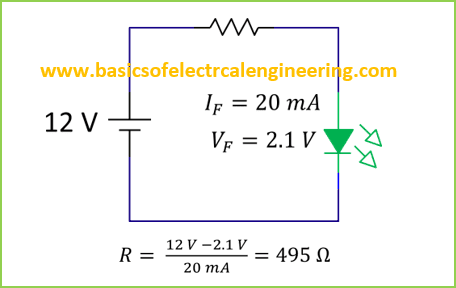
Let's consider that you are using a green LED rated at 2.1 V and 20 mA. The input is a 12 V battery which powers the circuit. Using Ohm's law we can find the value of resistor as shown below:

The same procedure of calculation extends for all types of resistors you just need add leds and then perform the calculations.
7 Segment LED Display
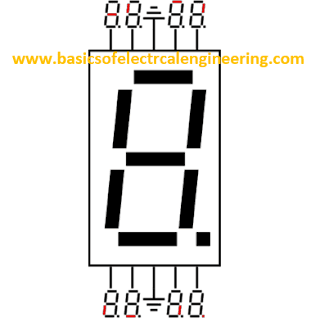
The 7 segment LED display is a combination of LEDs connected in different arrangments.

Difference between LED and Photodiode
LED is a light emitting diode which operates in the forward bias condition, whereas the photodiode is a sensor diode which operates in the reverse bias direction. Originally the resistance of photodiode is very high. The incident light falls on the diode and decreases the resistance thus facilitating the reverse current flow. Symbols of both components are same with the difference being arrow directions are reversed.
So that was all about basics of LED.
Learn more about:
So that was all about basics of LED.
Learn more about:




No comments:
Post a Comment