

An ammeter is an electrical instrument which measures electrical current.
You always follow two steps for measuring current:
- Disconnect the circuit
- Connect the ammeter in series
Also learn:
Basics of Current measurement using Ammeter
However, the internal resistance of ammeter impacts the current as well.
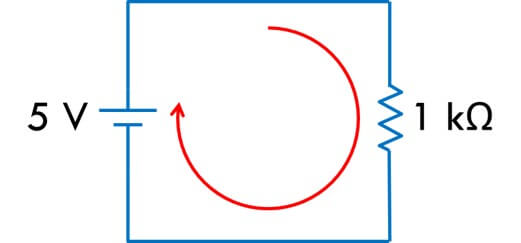
Let's consider a 5 V source that is connected to a 1 kΩ.

From
Ohm's law
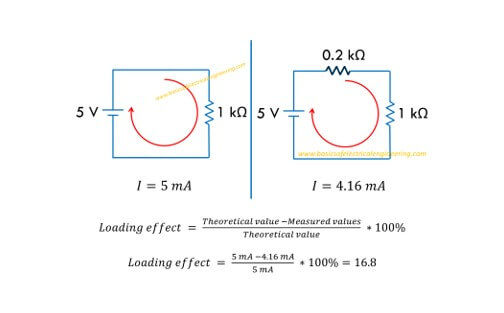
, the current passing through the circuit is 5 mA. (I = V/R)
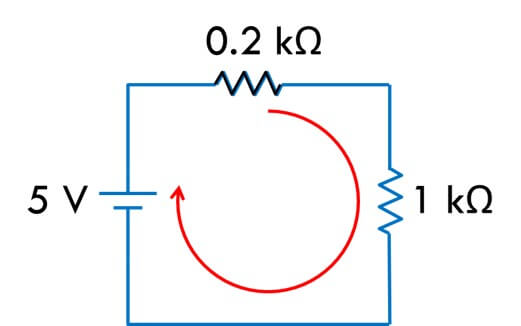
Let's hook an ammeter having 0.2 kΩ internal resistance in series.

The overall current in circuit is now 4.16 mA. (I = V/R = 5 V / (0.2 + 1) = 5 V / 1.2 k = 4.16 mA)
The ammeter will display 4.16 mA whereas the actual current is 5 mA. This difference of actual and measured current is technically termed as loading effect of an ammeter.

Let's reconsider the above example with an ammeter of 0.01 kΩ.
The current I is now 4.95 mA. (I = V/R = 5 V / 1.01 kΩ = 4.95 mA
The loading effect now reduced from 16.8% to 1.2%.
I = (5 mA - 4.94 mA)/5 mA = 1.2%
We observe that with a lower internalresistancee the loading effect reduced from 16.8% to 1.2%.
That is what it happens in practical ammeters. Practical meters are designed to keep the internal resistance as much smaller as it is possible.


![Basic Properties of Electrical Circuits: Voltage, Current, Resistance, Power [The Mountain Analogy]](/-bBCMdrhXXj4/WWzcjdFJOLI/AAAAAAAAC2Y/SI648RXRAyg4qk2RnxaQrsKv5zZ406lHQCK4BGAYYCw/w72-h72-p-k-no-nu/basic-quantities-of-electrical-engineering.png)
![Current Divider Rule [Statement, Formula, Examples, and Derivation]](/-N2qCkKhSbLk/WoPosMEnFII/AAAAAAAAEP4/Zd9fKT2IM5Y6mUSrS1VDII1zyRbkHYDPwCK4BGAYYCw/w72-h72-p-k-no-nu/general-current-divider-formula.jpg)
No comments:
Post a Comment