

In our previous tutorial, we learned the application of
Branch current analysis
in a 2 loop circuit with an example.
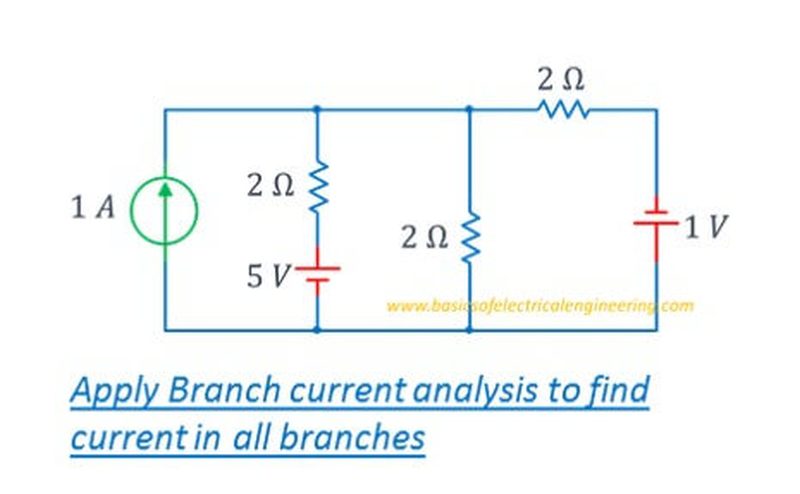
In this example, a network having three loops is solved using branch current analysis.
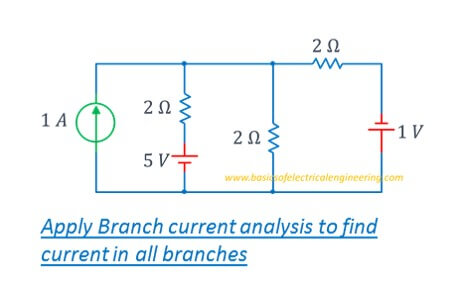
In this example, a network having three loops is solved using branch current analysis.

Step 1: Let's first label the circuit:

Step 2: Apply the
Kirchhoff's voltage law
in the loop between I2 and I3.
5 V = 2 I
2
- 2 I
3
... (1)
Step 3: Apply KVL in the right loop.
1 V = 2 I 3 + 2 I 4 ... (2)
Step 4: Apply Kirchhoff's current law at node a.
1 A + I 2 + I 3 = I 4 ... (3)
Solving the three equations we obtain our final answers:
I 2 = 1.5 A
I 3 = - 1 A
I 4 = 1.5 A
Negative sign with current I 3 indicates that actual current flow is opposite to our assumed direction of the current.
Step 3: Apply KVL in the right loop.
1 V = 2 I 3 + 2 I 4 ... (2)
Step 4: Apply Kirchhoff's current law at node a.
1 A + I 2 + I 3 = I 4 ... (3)
Solving the three equations we obtain our final answers:
I 2 = 1.5 A
I 3 = - 1 A
I 4 = 1.5 A
Negative sign with current I 3 indicates that actual current flow is opposite to our assumed direction of the current.


![Basic Properties of Electrical Circuits: Voltage, Current, Resistance, Power [The Mountain Analogy]](/-bBCMdrhXXj4/WWzcjdFJOLI/AAAAAAAAC2Y/SI648RXRAyg4qk2RnxaQrsKv5zZ406lHQCK4BGAYYCw/w72-h72-p-k-no-nu/basic-quantities-of-electrical-engineering.png)

No comments:
Post a Comment